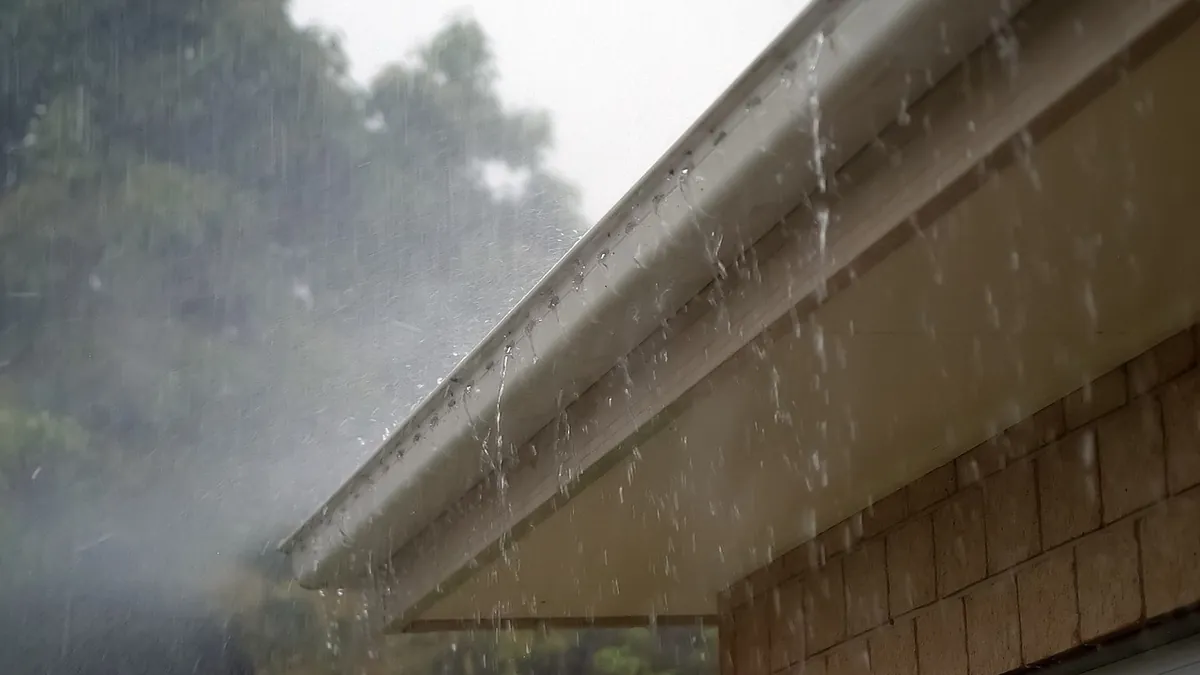
When heavy rain sends water cascading over the edges of your gutters, it’s more than just an annoyance. It signals a problem with your home’s drainage system that can lead to significant issues, from damaged landscaping and foundations to compromised siding and basements. Understanding why gutters overflow in heavy rain involves looking at several factors: the physical dimensions of the gutters, the presence of blockages, the angle at which they’re installed, and even the design of your roof. Addressing these elements is key to maintaining an effective rainwater management system around your home.
Key Differences Between Gutters Overflowing in Heavy Rain and Overflowing Gutters
While the phrases “gutters overflowing in heavy rain” and “overflowing gutters” might seem interchangeable, there’s a subtle but important distinction.
“Gutters overflowing in heavy rain” specifically points to a scenario where the volume of water from the roof exceeds the gutter system’s capacity during intense precipitation. This implies the system might function adequately under normal rainfall but fails when pushed to its limits. It often suggests a design or capacity issue rather than a constant, everyday problem. For instance, a gutter system perfectly sized for an average rainfall might be overwhelmed during a sudden downpour, causing water to spill over. The practical implication here is that the system itself might not be inherently flawed for typical conditions, but it’s not robust enough for extreme weather events. The trade-off is often between initial cost and maximum capacity. A larger, more robust system costs more to install but handles heavy rain better. An edge case might involve a relatively new, clean gutter system on a correctly pitched roof still overflowing, indicating the sheer volume of water is too much for its size.
“Overflowing gutters,” on the other hand, is a more general term. It describes any situation where water spills over the gutter edges, regardless of the intensity of the rain. This could happen during light rain if the gutters are severely clogged, improperly pitched, or damaged. This phrase often points to a maintenance or installation flaw that causes consistent issues. For example, a gutter filled with leaves and debris will overflow even during a moderate shower because the water cannot flow freely to the downspout. The practical implication is that the system has a fundamental problem that needs addressing, regardless of weather severity. The trade-off is often between regular maintenance effort and system performance. Neglecting cleaning will inevitably lead to overflowing. An edge case here could be a perfectly clean gutter overflowing due to a manufacturing defect in a section, causing a sag.
In essence, “gutters overflowing in heavy rain” focuses on the intensity of the precipitation as the primary trigger, suggesting a capacity limitation. “Overflowing gutters” is a broader term that encompasses various causes, often pointing to ongoing maintenance or installation deficiencies, even under less severe conditions.
Shared Benefits and Overlaps
Both “gutters overflowing in heavy rain” and “overflowing gutters” share common underlying principles and potential consequences, even if their immediate triggers differ. The core idea is that water is not being effectively channeled away from a structure.
The primary shared benefit of understanding these issues is the preservation of your home’s structural integrity. When gutters overflow, whether due to heavy rain or other factors, the uncontrolled water can erode soil around the foundation, leading to cracks, settlement, and even basement flooding. It can also cause splash-back onto siding, leading to rot, mold, and mildew. Prolonged exposure to excess moisture can compromise window frames, doorframes, and fascia boards.
An overlap exists in the investigative process. Regardless of whether the overflow is triggered by heavy rain or consistently occurs, the diagnostic steps often involve checking for clogs, verifying proper pitch, assessing gutter size, and inspecting downspout functionality. For instance, a partially clogged gutter might only overflow in heavy rain, but a completely blocked one will overflow in any rain. The underlying issue is the same (debris), but the manifestation differs based on rain volume.
Both scenarios also share the potential for significant damage. Water infiltration into basements, crawl spaces, and even wall cavities is a common and costly consequence. This can lead to expensive repairs, health hazards from mold growth, and decreased property value. The trade-off here is preventative maintenance versus reactive repair. Investing time and resources into ensuring your gutter system is properly sized, clean, and correctly installed is far less expensive than repairing foundation damage or water-damaged interiors.
Consider a home with a small, older gutter system. During a typical summer shower, it might perform adequately. However, during a torrential thunderstorm, the sheer volume of water quickly overwhelms its capacity, leading to “gutters overflowing in heavy rain.” If that same system then accumulates leaves and debris over the fall, it might start “overflowing gutters” even during a light drizzle, because its already limited capacity is further reduced. In both cases, the water is causing damage, and the solution involves addressing capacity, cleanliness, and potentially pitch.
When Gutters Overflowing in Heavy Rain May Be a Better Fit
Focusing specifically on “gutters overflowing in heavy rain” is particularly relevant when the issue arises only during intense downpours, and the gutter system appears to function adequately under normal conditions. This suggests that the primary problem isn’t a constant blockage or a completely failed installation, but rather a limitation in capacity for extreme weather events.
This perspective is a better fit when:
- Your gutters are visibly clean and clear of debris: If you regularly clean your gutters and downspouts, and there are no obvious blockages, yet water still spills over during heavy storms, it points to a volumetric issue. The system simply cannot handle the sheer amount of water flowing off the roof.
- The overflow is widespread along multiple sections: If only one small section overflows, it might indicate a localized sag or blockage. But if large portions of your gutter system are overwhelmed simultaneously during heavy rain, it suggests the overall design or sizing is inadequate for the roof’s runoff potential.
- You live in an area prone to sudden, intense rainfall: Regions with monsoon seasons, tropical storms, or frequent severe thunderstorms experience higher rates of precipitation. Gutter systems designed for average rainfall in other climates may be insufficient here.
- You’ve recently changed your roof or added an extension: A new roof with a steeper pitch or a larger footprint will increase the volume and velocity of water flowing into the gutters. If the existing gutters weren’t upgraded to match, they’re likely to overflow in heavy rain.
- Your downspouts appear to be the bottleneck: Sometimes the gutters themselves are adequately sized, but the downspouts are too few, too small, or too far apart to carry the water away quickly enough, causing a backup in the main gutter troughs during heavy flow.
For example, imagine a homeowner in Florida who has a well-maintained, standard 5-inch gutter system. For most of the year, it works fine. But when a tropical storm brings several inches of rain per hour, the gutters are completely overwhelmed, with water sheeting off the roof edges. Here, the problem isn’t debris; it’s the sheer volume of water exceeding the system’s capacity. The solution might involve upgrading to 6-inch gutters, adding more downspouts, or installing larger downspouts to handle the increased flow rate. The trade-off is the initial investment in a more robust system versus the ongoing risk of water damage during severe weather.
When Overflowing Gutters May Be a Better Fit
The broader term “overflowing gutters” is a more appropriate descriptor when the problem isn’t exclusively tied to heavy rainfall, but rather occurs under various conditions, including moderate or even light precipitation. This typically points to more fundamental issues with maintenance or installation that are causing consistent failures.
This perspective is a better fit when:
- Overflow occurs during light or moderate rain: If your gutters are spilling water even when the rain isn’t particularly intense, it’s a strong indicator of a blockage or a significant pitch problem. The system’s capacity is compromised even under low-stress conditions.
- Visible debris or blockages are present: This is the most common cause of overflowing gutters. Leaves, twigs, shingle grit, nests, and other debris accumulate, forming dams that prevent water from flowing freely to the downspouts. Even a partial clog can significantly reduce a gutter’s effective capacity.
- The overflow is localized to specific sections: If only one or two sections of your gutters consistently overflow, it often indicates a sag in that particular section, a concentrated clog, or a downspout blockage in that area.
- Gutters are visibly pulling away from the fascia: When gutters detach or sag, they lose their proper pitch, creating low spots where water collects and eventually overflows. This isn’t a capacity issue, but a structural installation problem.
- Downspouts are visibly clogged or disconnected: If water is backing up at the downspout opening or if the downspout itself is completely blocked, the main gutter trough will quickly fill and overflow, regardless of rain intensity.
Consider a house where the gutters haven’t been cleaned in several years. Even a light drizzle causes water to stream over the edges because the troughs are packed solid with decomposing leaves and debris. Here, the problem is not the size or design of the gutters in relation to heavy rain; it’s a lack of basic maintenance. The immediate solution is cleaning, and the long-term solution is a regular maintenance schedule. The trade-off is the effort of routine cleaning versus the predictable damage from neglected gutters.
How to Choose Based on Goals and Context
Deciding how to approach your overflowing gutter problem depends entirely on the specific symptoms, your environmental context, and your long-term goals for home maintenance and protection. The choice isn’t about one term being “better” than the other, but about accurately diagnosing the root cause to implement the most effective solution.
| Factor | “Gutters Overflowing in Heavy Rain” (Capacity Issue) | “Overflowing Gutters” (Maintenance/Installation Issue) |
|---|---|---|
| Primary Cause | Insufficient gutter/downspout size for roof runoff volume during intense storms. | Blockages (leaves, debris), improper pitch, damage, disconnected downspouts. |
| When it occurs | Only during periods of very heavy, intense rainfall. | During light, moderate, or heavy rain; often consistently. |
| Visible Clues | Gutters appear clean, but water overwhelms them quickly during downpours. | Visible debris, sagging sections, water spilling even during light rain, localized. |
| Initial Focus | Assess roof area, calculate required gutter capacity, inspect downspout sizing. | Clean gutters, check for clogs, verify pitch, inspect for damage/detachment. |
| Potential Fixes | Upgrade to larger gutters (e.g., 6-inch), add more downspouts, larger downspouts. | Regular cleaning, re-pitching, re-attaching, repairing damaged sections, re-routing. |
| Cost Implication | Higher upfront cost for system upgrades, but potentially long-term protection. | Lower ongoing cost for maintenance, but potential for recurring issues if neglected. |
| Risk Profile | High risk of damage during severe weather if not addressed. | Consistent, ongoing risk of damage if maintenance is ignored. |
Contextual Considerations:
- Climate: If you live in a region with frequent intense storms, prioritizing gutter capacity (addressing “gutters overflowing in heavy rain”) becomes paramount. In a drier climate with occasional light rain, routine cleaning (addressing “overflowing gutters” due to blockages) might be sufficient.
- Roof Characteristics: Large, steep roofs shed water at a much higher rate. If you have such a roof, you’re more likely to encounter capacity issues during heavy rain. Complex rooflines with many valleys can also concentrate water flow, overwhelming specific gutter sections.
- Surrounding Vegetation: If your property is surrounded by deciduous trees, you’ll inevitably deal with leaf debris. This makes regular cleaning or installing gutter guards (to prevent “overflowing gutters” from clogs) a high priority.
- Budget: Major gutter system upgrades (larger size, more downspouts) are a significant investment. Routine cleaning and minor repairs are more budget-friendly. Your budget will influence the scale of your solution.
- DIY vs. Professional: Cleaning gutters is often a DIY task for many homeowners, but re-pitching, replacing sections, or designing a new system for increased capacity usually requires professional expertise.
Ultimately, diagnosing the problem accurately is the first step. If your gutters are clean and well-maintained but still overflow during a deluge, you’re looking at a capacity problem (gutters overflowing in heavy rain). If they overflow even with moderate rainfall and you see debris or sags, it’s primarily a maintenance or installation issue (overflowing gutters). A thorough inspection, ideally during a rain event, can provide the clearest answers.
Frequently Asked Questions
What is gutters overflowing in heavy rain?
Gutters overflowing in heavy rain refers specifically to a situation where the volume of rainwater flowing off a roof during an intense downpour exceeds the capacity of the installed gutter system. This means the gutters, though potentially clean and properly installed, are simply not large enough, or don’t have enough downspouts, to channel away the unusually high amount of water generated by severe weather. It’s distinct from overflowing due to blockages, though blockages can exacerbate the problem.
How does gutters overflowing in heavy rain compare with alternatives?
The “alternative” to gutters overflowing in heavy rain is a gutter system that effectively manages all rainfall, even during intense storms. This comparison highlights the difference between an underperforming system and an optimal one.
| Feature | Gutters Overflowing in Heavy Rain (Underperforming) | Effective Gutter System (Optimal) |
|---|---|---|
| Performance | Fails to manage water during heavy rainfall, leading to spillage. | Channels all rainwater efficiently off the roof and away from the foundation. |
| Capacity | Inadequate for peak rainfall rates in the specific climate/roof design. | Sized appropriately for the roof’s square footage, pitch, and local rainfall intensity. |
| Maintenance | May be clean, but still overwhelmed; or exacerbated by partial clogs. | Regularly cleaned and maintained, ensuring free flow of water. |
| Downspouts | Too few, too small, or poorly located, causing bottlenecks during high flow. | Sufficient number, adequate size, and strategically placed to handle runoff. |
| Pitch | May be correct, but system size is the limiting factor; or incorrect, worsening it. | Correctly pitched (typically 1/4 inch per 10 feet) to ensure positive drainage. |
| Consequences | Foundation damage, landscape erosion, siding damage, basement flooding. | Protection of foundation, landscaping, and exterior surfaces; prevents water intrusion. |
| Solution Focus | Upgrading system size, adding downspouts, improving flow pathways. | Routine cleaning, minor repairs, ensuring proper installation. |
In essence, an underperforming system is one that cannot keep up with its primary function when challenged by significant weather, while an effective system is designed and maintained to handle those challenges without issue.
What are the most common mistakes people make with gutters overflowing in heavy rain?
People often make several key mistakes when dealing with gutters overflowing in heavy rain:
- Assuming all overflows are due to clogs: While clogs are a primary cause of overflowing gutters, they aren’t the only one. Many homeowners diligently clean their gutters but still experience overflow during heavy rain, failing to realize the system itself is undersized.
- Ignoring the problem: Overflows are often dismissed as a minor inconvenience, especially if they only happen occasionally. This neglect can lead to severe and costly damage to foundations, basements, landscaping, and siding over time.
- Underestimating roof runoff: People often don’t consider the sheer volume of water a roof can shed. A single inch of rain on a 1,000 square foot roof generates over 600 gallons of water. Heavy rain can dump several inches per hour, quickly overwhelming standard gutter sizes.
- Improperly sizing new gutters: When replacing gutters, some homeowners simply install the same size as before without considering modern rainfall data, roof changes, or the actual needs of their home. A professional can help calculate appropriate gutter and downspout sizes based on roof area, pitch, and local rainfall intensity.
- Insufficient downspouts: Even large gutters can overflow if the water can’t exit fast enough. Not having enough downspouts, or having downspouts that are too small, creates bottlenecks. A general rule of thumb is one downspout for every 30-40 feet of gutter, but this can vary.
- Incorrect pitch: Gutters need a slight slope (typically 1/4 inch per 10 feet) towards the downspouts to ensure water drains properly. If they are level or pitched incorrectly, water will pool and eventually spill over, even if clean.
- Neglecting downspout extensions: Even if gutters and downspouts work perfectly, if the water is simply dumped at the base of the foundation, it can still cause damage. Extensions are crucial to direct water several feet away from the house.
- DIY repairs without understanding the root cause: Patching a leak or cleaning a visible clog might offer temporary relief, but if the underlying issue is systemic (like undersized gutters or poor pitch), the problem will persist or reappear.
By addressing these common mistakes, homeowners can move towards a more effective and durable solution for managing rainwater.
Conclusion
Understanding why your gutters overflow during heavy rain involves more than just a quick glance for leaves. It requires a comprehensive look at the entire system, from the size and pitch of the gutters themselves to the capacity of the downspouts and even the design of your roof. Whether the issue stems from a simple clog or a fundamental design limitation, the consequences of uncontrolled water flow can be significant and costly. By accurately diagnosing the root cause – be it a maintenance oversight or an undersized system struggling with intense rainfall – homeowners can implement targeted solutions that protect their property and ensure their home’s drainage system is up to the task, rain or shine.
DIY safety disclaimer
Home Leak Fix publishes general DIY information for homeowners. Water intrusion can involve structural, electrical, height, mould, or insurance risks. Use proper safety equipment, follow local building rules, and call a qualified professional when a repair is unsafe, unclear, or beyond your experience.